What counts as chocolate depends on where you buy it. In the UK, chocolate must contain at least 35% total dry cocoa solids, and milk chocolate at least 25%. In the US, the measure is chocolate liquor: at least 35% for bittersweet or semisweet, 15% for sweet and 10% for milk chocolate. France applies the same European minimums.
Chocolate is one of the few foods whose very name is protected by law. Fall below the minimums and a product cannot be sold as chocolate at all, however it looks in the wrapper.
The rules side by side
| Category | UK and France | US |
|---|---|---|
| Chocolate (dark) | 35% total dry cocoa solids, including 18% cocoa butter | Bittersweet or semisweet: 35% chocolate liquor |
| Sweet chocolate | Not a separate category | 15% chocolate liquor |
| Milk chocolate | 25% total dry cocoa solids and 14% dry milk solids | 10% chocolate liquor |
| Family milk chocolate | UK only: 20% total dry cocoa solids and 20% dry milk solids | Not a category |
| White chocolate | 20% cocoa butter and 14% dry milk solids | 20% cocoa butter, 14% total milk solids and 3.5% milkfat (FDA) |
| Other vegetable fats | Up to 5%, from a short list, with a warning on the pack | The product must be renamed, for example “vegetable fat coating” |
Sources: Cocoa and Chocolate Products (England) Regulations 2003, Schedule 1; DGCCRF; 21 CFR 163.123; 21 CFR 163.130. For a fuller table by country, see our guide to cocoa percentage in chocolate.
The UK rules
UK law counts total dry cocoa solids: everything in the bar that came from the cacao bean, including both cocoa butter and the non-fat cocoa solids. Chocolate needs at least 35%, of which at least 18% must be cocoa butter and at least 14% non-fat cocoa solids.
The UK also keeps a category all its own: family milk chocolate, lower in cocoa and higher in milk, with at least 20% cocoa solids. It is a distinctly British and Irish idea, with no US equivalent.
The French rules
France follows the same European minimums, but French rules, overseen by the consumer authority DGCCRF, go further in protecting what chocolate may be called (DGCCRF):
- Vegetable fats. Only six fats other than cocoa butter are allowed: illipe, palm, sal, shea, kokum gurgi and mango kernel, up to 5% of the chocolate. The pack must then say, in bold near the product name, that it contains vegetable fats in addition to cocoa butter.
- “Chocolat pur beurre de cacao”. Chocolate with no added vegetable fats may be sold as “chocolat pur beurre de cacao” (pure cocoa butter chocolate) or “chocolat traditionnel”.
- “Pâte de cacao”. The name cacao paste may only be used for a product made exclusively of cacao paste.
- Cocoa percentage. Chocolate must show its minimum cocoa content on the pack, written as “cacao : x % minimum”.
- “Artisanal”. The DGCCRF pursues misleading use of words such as “artisanal” and “fait maison”.
Other countries that protect chocolate and cacao
Beyond minimum cocoa content, a few places protect the name or the origin of chocolate and cacao themselves:
- Switzerland. Under the “Swissness” law, food may only be sold as Swiss if its main processing happens in Switzerland and it meets minimum Swiss-ingredient thresholds, including 80% of raw materials by weight and 100% for milk (Härting). Ingredients that cannot be grown in Switzerland, such as cocoa, are left out of the calculation (Swiss Federal Institute of Intellectual Property).
- Italy. Cioccolato di Modica, a traditional cold-worked chocolate from Sicily, became the first chocolate in Europe to receive Protected Geographical Indication status, in 2018 (GreenMe).
- Ecuador. Cacao Arriba, Ecuador’s fine-flavour cacao, is one of the country’s protected denominations of origin (El Universo).
Notice where most of this protection sits. Europe guards the names of finished chocolate and the places it is made; the countries that grow most of the world’s cacao have, with rare exceptions like Ecuador, far fewer protections for the bean itself. The value of a name tends to stay where the name is made.
The US rules
US law measures chocolate liquor, the ground cacao bean, calculated in a set way. Bittersweet and semisweet chocolate need at least 35%, sweet chocolate 15%, and milk chocolate 10%.
US rules are strict about fat. A product that swaps cocoa butter for other vegetable fats must change its name, to something like “sweet chocolate and vegetable fat coating”.
Why the rules measure differently
The UK and French figures count everything that came from the cacao bean as a share of the finished bar. The US figure counts chocolate liquor, using a formula that adjusts for fat. The two cannot be compared directly, which is why the percentage on the front of a pack tells you more than any legal minimum.
When a product is not chocolate
When cocoa hit record prices in 2024, some makers cut the cocoa in their recipes below the legal line. “Chocolate flavour”, “chocolatey” or “chocolate coating” on a pack usually means the product no longer qualifies. Read more in cocoa prices fell, so why is chocolate still expensive? and our guide to fake chocolate vs real chocolate.
Where Bantu Chocolate sits
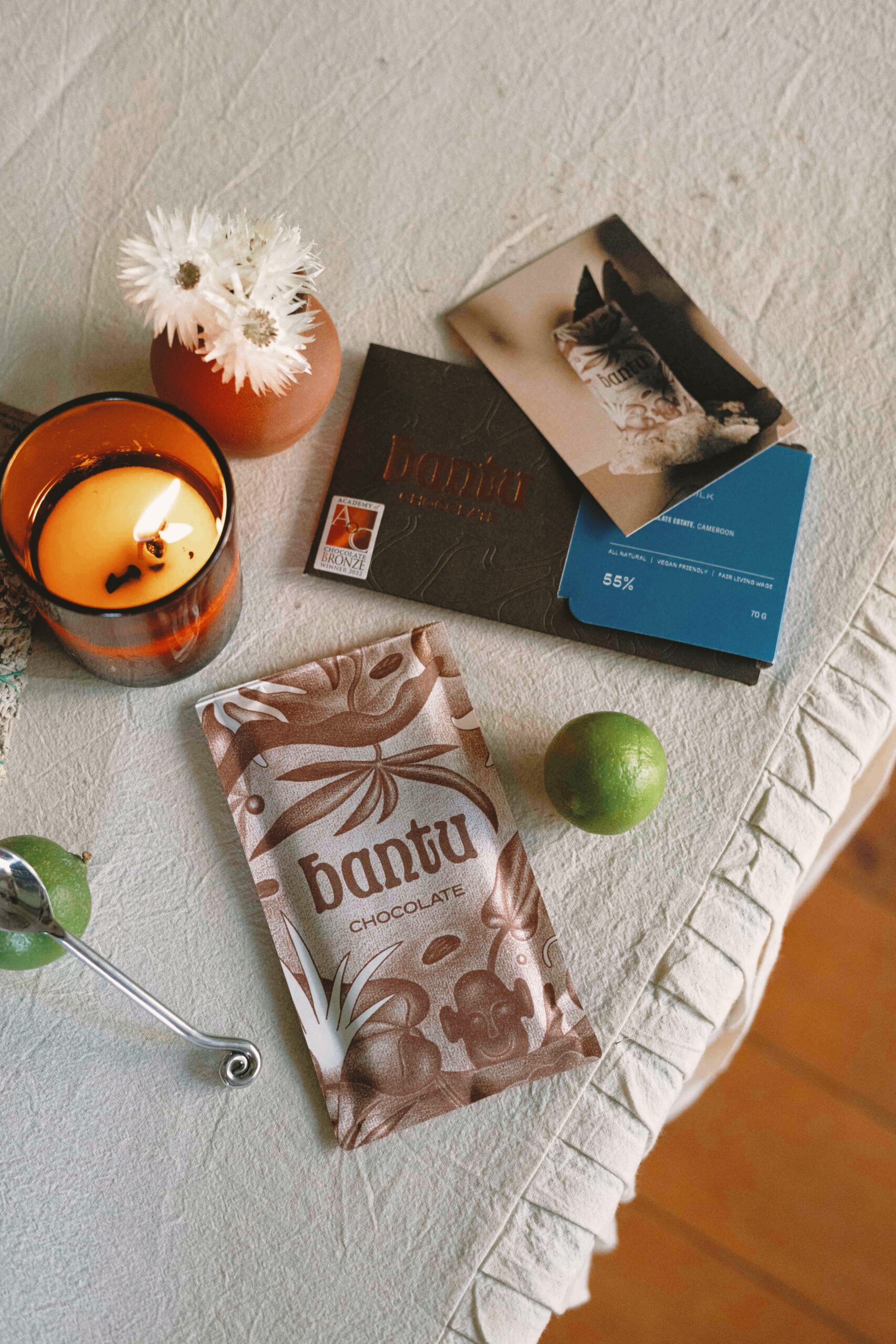
Every Bantu Chocolate bar begins with single-estate cacao from our family’s estate in Cameroon, with no palm oil and no emulsifiers, and carries the name of the place it was grown. Our darkest bar, Noire 73%, holds more than twice the UK legal minimum of cocoa solids.
FAQs
Chocolate and the Law
Chocolate must contain at least 35% total dry cocoa solids, and milk chocolate at least 25%, under the Cocoa and Chocolate Products (England) Regulations 2003.
US law sets minimum chocolate liquor content: 35% for bittersweet or semisweet chocolate, 15% for sweet chocolate and 10% for milk chocolate.
It is a French label for chocolate made with no vegetable fats other than cocoa butter.
In the UK, France and the EU, yes, up to 5% from a short list of approved fats, with a warning on the pack. In the US the product must then be renamed.
It usually means the product does not meet the legal minimums to be called chocolate.
Written by Bantu Chocolate.