
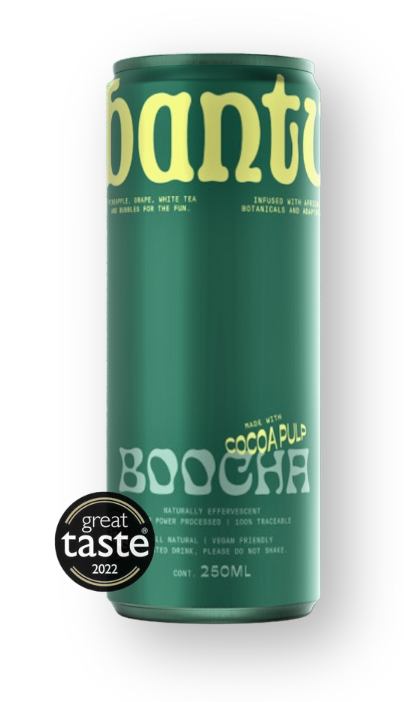
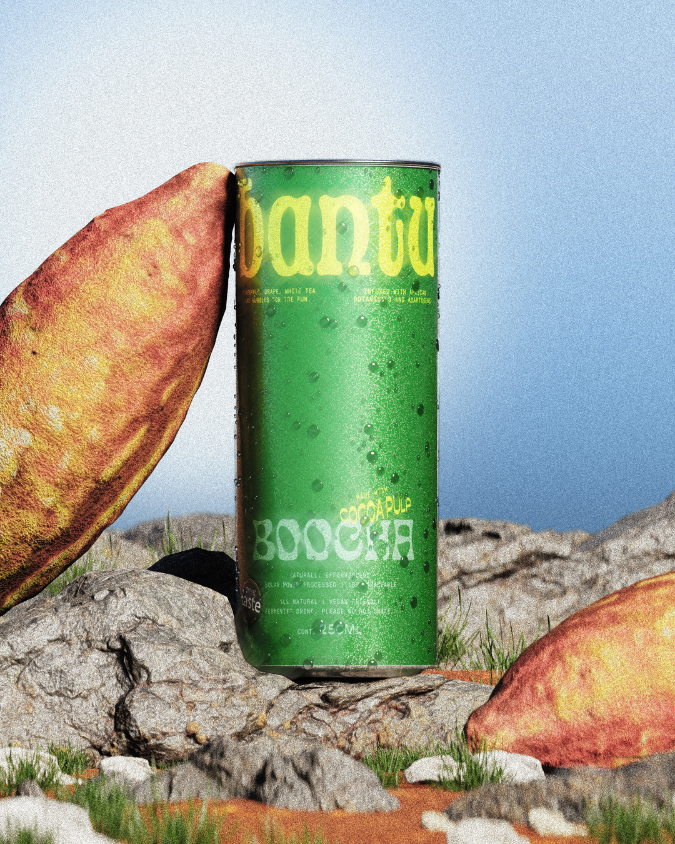
Boocha Cacao Fruit Juice Kombucha
£20.00
Free shipping in Britain on orders over £25
Delivery InfoSee how our cocoa bean prices compare with Fairtrade, slavery-free, and global commodity prices.
Price Comparison All Natural
 Dairy Free
 Gluten Free
 No Lecithin
 Soy Free
 Vegan
Vegan
Pre-order. Ships from February 2027.
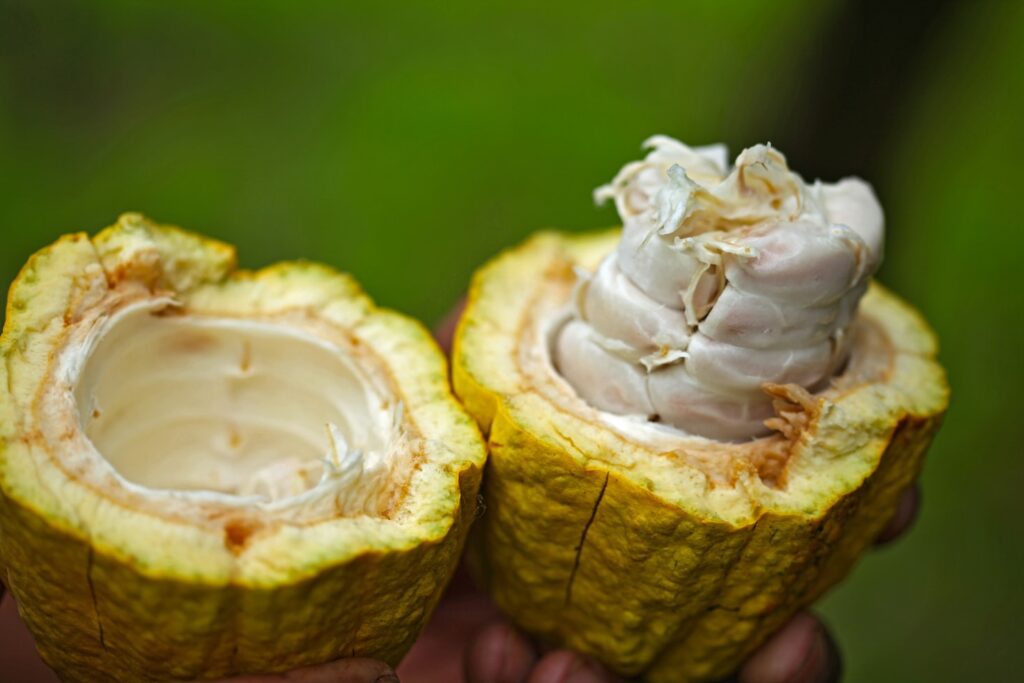
Boocha is a kombucha brewed with cacao fruit pulp, the sweet white fruit surrounding the cacao bean, which is discarded during fermentation in conventional chocolate production. It tastes nothing like chocolate: expect bright tropical notes closer to yuzu and lychee, apricot sweetness, and a honeyed finish over the light acidity of the kombucha base.
What it tastes like
Nothing like chocolate, which surprises most people. Bright and tropical, closer to yuzu and lychee, with apricot sweetness and a honeyed finish over the clean acidity of the ferment. Lightly sparkling. Most people take a second sip before they work out what it reminds them of.
Live cultures
Boocha is made with genuine fermented kombucha, pasteurised for shelf stability. We then dose live Bacillus coagulans after pasteurisation, a heat-stable spore-forming strain at 1 to 2 billion CFU per can. It is one of very few strains that survives both shelf storage and stomach acid.
Sugar and alcohol
Around 9g of sugar per 250ml can, against 20 to 25g in a typical fruit juice and 25 to 30g in a soft drink. The sugar comes from the cacao pulp itself and from the organic cane sugar the fermentation feeds on, most of which is consumed in the process. Under 0.5% ABV, the standard threshold for non-alcoholic drinks in the UK, US and EU. Fermentation produces trace alcohol naturally.
When to drink it
Morning, in place of juice. Three in the afternoon, in place of the second coffee. Six in the evening, over ice with a twist, in place of a drink you would rather not have.
Ingredients
Filtered Water, Kombucha Culture, Organic Raw Cane Sugar*, Cocoa Pulp Juice, Organic Tea*
*Certified Organic
Nutrition Facts Per 60g
- Energy 306kJ/62kcal
- Fat 0g
- Carbohydrates 15.90g
- of which Sugars 7.4g
- Fiber 2.2g
- Protein 0.5g
- Sodium 0
£20.00 or £20.00 / month
Free shipping in Britain on orders over £25
Delivery InfoSee how our cocoa bean prices compare with Fairtrade, slavery-free, and global commodity prices.
Price ComparisonWhat it tastes like
Nothing like chocolate, which surprises most people. Bright and tropical, closer to yuzu and lychee, with apricot sweetness and a honeyed finish over the clean acidity of the ferment. Lightly sparkling. Most people take a second sip before they work out what it reminds them of.
Live cultures
Boocha is made with genuine fermented kombucha, pasteurised for shelf stability. We then dose live Bacillus coagulans after pasteurisation, a heat-stable spore-forming strain at 1 to 2 billion CFU per can. It is one of very few strains that survives both shelf storage and stomach acid.
Sugar and alcohol
Around 9g of sugar per 250ml can, against 20 to 25g in a typical fruit juice and 25 to 30g in a soft drink. The sugar comes from the cacao pulp itself and from the organic cane sugar the fermentation feeds on, most of which is consumed in the process. Under 0.5% ABV, the standard threshold for non-alcoholic drinks in the UK, US and EU. Fermentation produces trace alcohol naturally.
When to drink it
Morning, in place of juice. Three in the afternoon, in place of the second coffee. Six in the evening, over ice with a twist, in place of a drink you would rather not have.
Ingredients
Filtered Water, Kombucha Culture, Organic Raw Cane Sugar*, Cocoa Pulp Juice, Organic Tea*
*Certified Organic







Our Product Range
Taste the difference
The difference between fairness as a marketing line, and fairness as a supply chain.
 | Ethical brands | Lab-made | |
|---|---|---|---|
| Ingredients | 3 | 5-8 | 12-20+ |
| Additives | None | often | yes |
| Organic | Sometimes | N/A | |
| Refined sugar | None | Sometimes | Varies |
| Single origin | Blended | No farm | |
| Family estate | no | No farm | |
| Regenerative | no | Not soil | |
FAQs
Cacao fruit pulp is the sweet white fruit surrounding the cacao bean inside the pod and our founder's first ever chocolate memory . It makes up roughly seventy percent of the pod by weight and is stripped off during fermentation in conventional chocolate production, then discarded. It tastes tropical rather than chocolatey: closest to lychee, yuzu and apricot.
Boocha contains less than 0.5% ABV, the standard threshold for non-alcoholic beverages in the UK, US and EU. Kombucha naturally produces trace alcohol during fermentation. Boocha is suitable for adults avoiding alcohol, though as with all kombucha we recommend children, pregnant people and those with alcohol sensitivity check with a healthcare provider.
Around 9g per 250ml can, against 20 to 25g in a typical fruit juice and 25 to 30g in a soft drink. It comes from the cacao fruit itself and from organic cane sugar, most of which the fermentation consumes. No fruit juice concentrate, no artificial sweeteners.
Boocha is brewed with a live kombucha culture and then pasteurised for shelf stability, which deactivates the original bacteria. To restore beneficial cultures we cold-dose Bacillus coagulans, a heat-stable spore-forming strain, after pasteurisation. Bacillus coagulans is one of the few strains that survives shelf storage and stomach acid at meaningful levels.
It was designed for it. Under 0.5% ABV, dry rather than sweet, and it holds up in a wine glass, which matters when everyone else is drinking something. The acidity also means it works with food rather than fighting it.
Two things. First, the base fruit ingredient is cacao pulp, an upcycled by-product of Bantu Chocolate's own cacao production in Cameroon, rather than the more common apple, ginger or berry. This gives Boocha its distinctive tropical-floral flavour. Second, we cold-dose Bacillus coagulans after pasteurisation to restore culture activity, which most shelf-stable kombuchas do not.
Upcycled ingredients are edible materials that would otherwise be discarded, redirected into food or drink products. In cacao, the pulp surrounding the bean is one of the largest wasted streams in the industry, the beans are fermented and the fruit is left behind. Boocha turns that fruit into a beverage.
Boocha contains trace alcohol (under 0.5% ABV) and natural caffeine from its green tea and oolong base (approximately 20–30mg per can). NHS guidance recommends avoiding kombucha during pregnancy due to variable alcohol content and unpasteurised varieties on the market. Boocha is pasteurised, but if you are pregnant or breastfeeding, please consult your midwife.
Boocha is shelf-stable for 12 months from production, stored between 4–20°C away from direct sunlight. Refrigerate before serving. Once opened, consume within 24 hours refrigerated, the natural carbonation and culture activity are best fresh.

Reviews
There are no reviews yet.